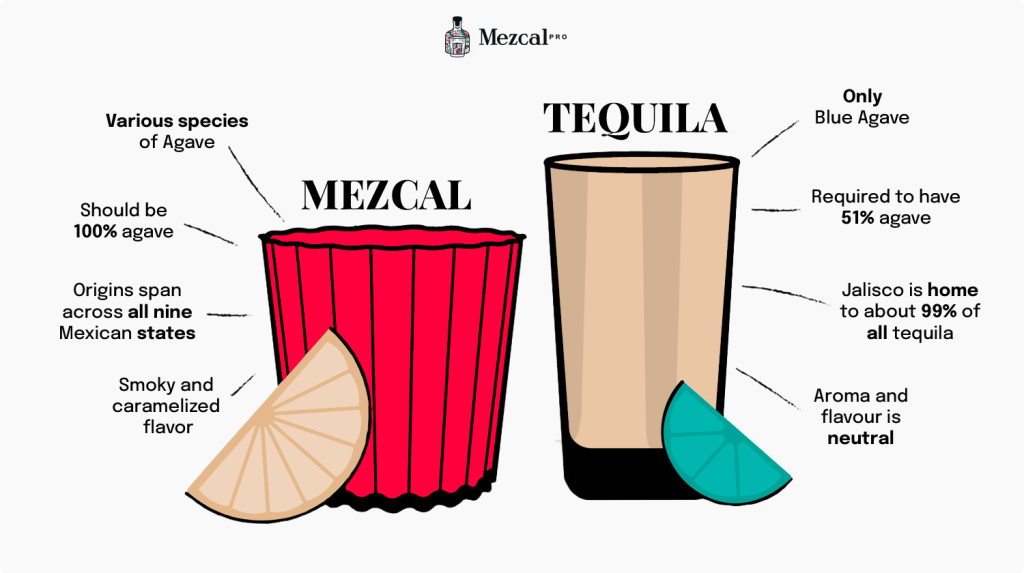
It’s the question we get asked most often at fairs, tastings, and long conversations after meals: what’s the difference between mezcal and tequila? Many people assume they are the same thing, or that mezcal is simply a smokier version of tequila. Neither of those assumptions is correct.
The reality is that mezcal and tequila are distant cousins that took very different paths. One chose industry. The other chose craft.
The origin: one plant, many stories
Both spirits come from agave, a succulent plant that has grown in Mexico for thousands of years. Indigenous peoples used it long before the arrival of the Spanish — to make fibers, food, medicine, and a fermented drink called pulque.
When the Spanish introduced distillation techniques in the 16th century, Mexicans began distilling agave and mezcal was born. Tequila came later, as a more industrialized and regional version of that same process, centered on blue agave and the state of Jalisco.
In that sense, every tequila is technically a type of mezcal. But not every mezcal is tequila. Mezcal is the origin. Tequila is a branch of that tree.
The raw material: blue agave vs thirty varieties
Tequila can only be made from one variety of agave: Blue Weber agave (Agave tequilana weber). Period. There are no exceptions.
Mezcal, on the other hand, can be produced from more than 30 different varieties of agave, each with its own flavor profile, maturation time, and personality. Espadín, Tobalá, Tepeztate, Madrecuixe, Arroqueño — each one tells a different story.
At Petricor, we work with Espadín agave, the most widely cultivated variety and the most accessible for those approaching mezcal for the first time. But the world of mezcal is vast, and each variety is its own universe.
The process: industry vs tradition
Here lies the most important difference — and the one you can taste in the glass.
Modern tequila is produced in factories. The agave is steamed in stainless steel autoclaves, the juice is extracted with industrial diffusers, fermentation is controlled with selected yeasts, and distillation happens in continuous columns. It is an efficient, fast process designed to produce large volumes consistently.
Artisanal mezcal like Petricor is made differently.
The agave is cooked in a cone-shaped pit oven dug into the earth, covered with volcanic stones heated by firewood for days. This slow process is what gives mezcal its characteristic smoky flavor — it is not an additive, but a natural consequence of fire and earth.
Then it is crushed, often with a tahona — a large round stone pulled by a horse or mule. It is fermented naturally in wooden vats, without artificial yeasts, allowing the environment to do its work. And it is distilled in copper stills, twice, patiently.
The result cannot be the same. Not because one is better than the other in absolute terms, but because they represent different philosophies of production.
The flavor: complexity vs consistency
Well-made blanco tequila is clean, fresh, with herbal and citrus notes. It is versatile, easy to mix into cocktails, and highly consistent from bottle to bottle.
Artisanal mezcal is something else. It is complex, smoky, with layers of flavor that evolve as you drink it. It can carry notes of fruit, earth, chocolate, herbs, or minerals. And it can vary significantly from one producer to another, from one harvest to another, from one agave variety to another.
That variability is not a flaw — it is exactly what makes it fascinating.
The denomination of origin: geography and rules
Tequila can only be produced in Jalisco and in certain municipalities of Guanajuato, Michoacán, Nayarit, and Tamaulipas.
Mezcal has its own denomination of origin that includes nine states: Oaxaca, Guerrero, Durango, San Luis Potosí, Zacatecas, Tamaulipas, Guanajuato, Michoacán, and Puebla. Oaxaca produces approximately 85% of the country’s mezcal.
Which one is better?
That is the wrong question.
Tequila is an extraordinary spirit with a rich history and producers who do exceptional work. Artisanal mezcal is a different expression — more intimate, more variable, more connected to the land and to the hands that produce it.
They are drinks for different moments and for people with different tastes. What we can say is this: if you have never tasted a true artisanal mezcal, slowly, in a wide glass and at room temperature, you are missing something that has no equivalent in the world of spirits.
That is what we do at Petricor.
And that is what we want you to discover.