There is a scene that repeats itself at many mezcal tastings. Someone lifts the glass, inhales with a solemn expression, takes a small sip, pauses dramatically, and says something like, “interesting, I detect a mineral finish with hints of wet earth and a smoky touch of oak.” Everyone nods.
That is not what we want for you.
Artisanal mezcal is an extraordinary drink — complex and full of nuance. But learning to enjoy it does not require technical vocabulary or a tasting diploma. It only requires attention, patience, and a willingness to be present in the moment.
Here is what really matters.
The glass: the first step no one takes seriously
The vessel you use to drink mezcal matters more than you think. Not because of elegance, but because of chemistry.
The traditional caballito — that small cylindrical glass we associate with tequila — is not the best choice for artisanal mezcal. It is too narrow and concentrates the alcohol in a way that can irritate the nose before you can perceive the more subtle aromas.
Ideally, you want a glass with a wide body and a mouth that gently narrows toward the top, like a wine glass or a glass specifically designed for mezcal. That shape allows aromas to gather right where your nose meets the rim.
If you do not have one of those, a wide-bottomed whiskey glass works perfectly well. What matters is space, not labels.
The temperature: never with ice
Ice is the enemy of artisanal mezcal.
When mezcal gets cold, aromatic compounds contract and become less volatile — meaning fewer aromas reach your nose. The flavor flattens. The complexity disappears. What would be a layered experience at room temperature becomes something generic with ice.
The ideal serving temperature for artisanal mezcal is room temperature, between 18 and 22 degrees Celsius. On a hot day, you can slightly cool the glass — but never put ice directly into the liquid.
If you want something cold, mezcal in a cocktail is an excellent option. But if you want to truly understand what you are drinking, serve it neat and at room temperature.
The first approach: smell before you drink
Before taking the first sip, bring the glass to your nose and smell gently. Do not push your nose all the way in — alcohol at that distance can overwhelm your receptors. Keep the glass about one or two inches from your nose and breathe slowly.
What do you notice first? Most likely the smoke — the most immediate characteristic of artisanal mezcal. But wait a moment. After the smoke, there are other things: something sweet, something herbal, perhaps something fruity or floral depending on the agave variety and the producer.
Now gently tilt the glass and let the mezcal touch the sides. Smell again. Contact with air opens the mezcal and releases new aromas that were not present at first.
That opening process — just like with wine — can take several minutes. Do not rush.
The first sip: let it speak
When it is time to drink, take a small sip and hold it in your mouth for a few seconds before swallowing.
Let the mezcal touch your entire tongue — the sides, the tip, the center. Different areas perceive different flavors, and artisanal mezcal has enough complexity for each area to tell you something different.
The smoke will likely arrive first, bold and enveloping. Then come the secondary flavors: sweet, earthy, herbal, mineral. And after you swallow, there will be a finish — that lingering sensation that remains in the mouth — which can last several minutes in a well-made mezcal.
That long finish is one of the signs of quality in artisanal mezcal. It means what you are drinking has real depth, not just immediate impact.
The pairing: tradition with purpose
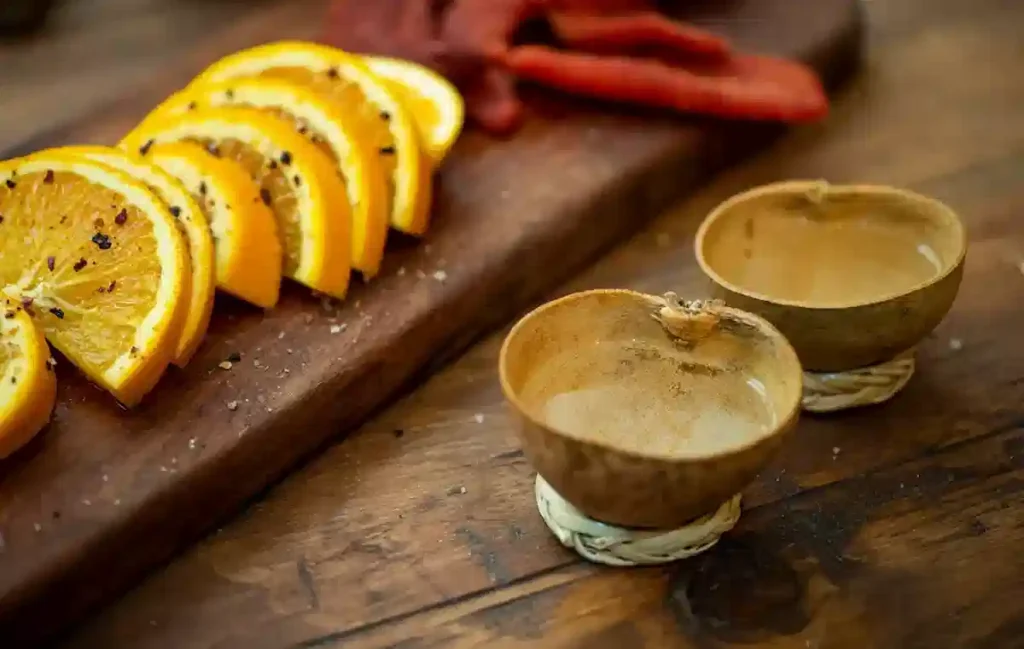
Oaxacan tradition says mezcal should be served with a slice of orange and sal de gusano. It is not a gimmick — it makes sense.
The orange cleanses the palate between sips, removing the smoky residue and preparing the mouth for the next taste. Sal de gusano — made from salt, chili, and dried larvae of a worm that lives in agave — adds an umami, earthy flavor that complements mezcal beautifully.
Other pairings that work exceptionally well with artisanal mezcal:
- Dark chocolate with more than 70% cacao — the bitterness of the chocolate and the smokiness of the mezcal complement each other surprisingly well.
- Aged cheese or cured goat cheese — the fat softens the alcohol and highlights more subtle notes.
- Toasted grasshoppers (chapulines) with lime — if you are adventurous, this is one of the most traditional Oaxacan pairings.
- Stewed tacos — mezcal and traditional Mexican food were made for each other.
The toast ritual: a meaningful “salud”
In Oaxaca, there is a traditional way to toast with mezcal that is worth knowing.
Before taking the first sip, you tilt the glass slightly and let a small drop fall to the ground — an offering to the earth, the agave, and those who are no longer with us. Then you say:
“For everything bad, mezcal. For everything good, the same.”
It is not required, but it is a beautiful gesture that connects the act of drinking to something larger than yourself.
What it really means to drink like an expert
After everything above, there is one important thing to clarify.
Drinking mezcal like an expert does not mean identifying every aromatic compound or using the right vocabulary at a tasting. It means being present. It means taking the time to smell, to taste, and to notice what is in the glass before reaching for the next one.
Artisanal mezcal is the result of years of work — the patience of the plant and the mezcaleros, a process with no shortcuts. The only way to honor that is to pay attention.
You do not need to be an expert.
You just need to be there — calmly, without hurry.
That is all.