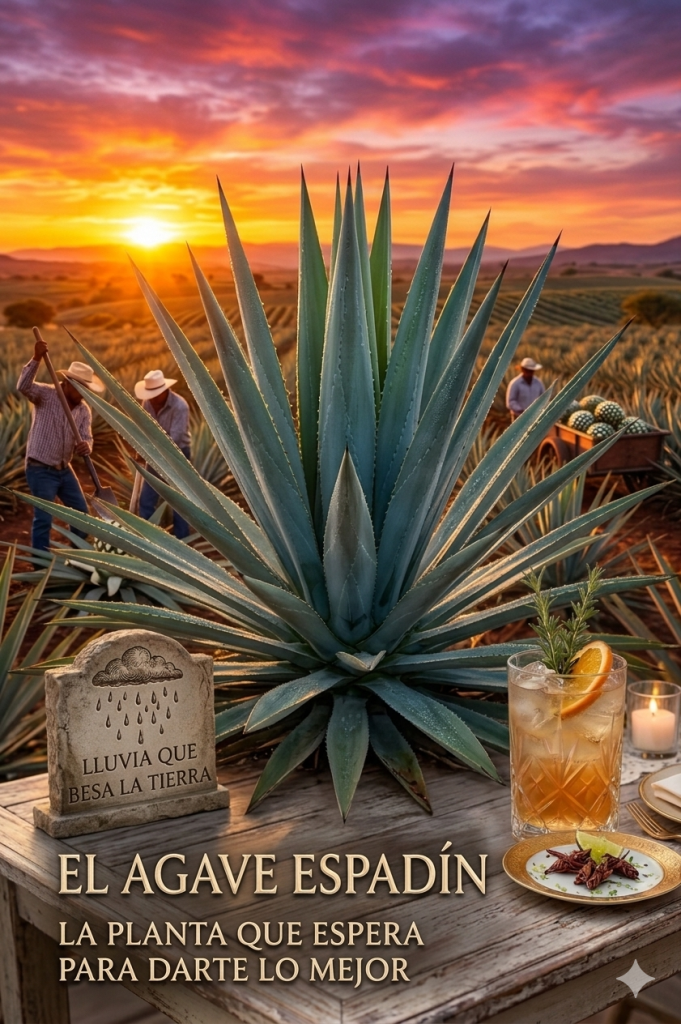
Espadín Agave: The Plant That Waits to Give You Its Best
There is something deeply philosophical about agave. A plant that spends its entire life storing energy, sugars, and character — only to give everything it has once, and then die. There is no second chance. No turning back. Just that single moment when it delivers everything it saved for years.
In that way, it resembles the things that truly matter.
Espadín agave is the variety we work with at Petricor, and understanding it is key to understanding why artisanal mezcal is unlike any other spirit in the world.
A name that comes from its shape
Agave angustifolia is its scientific name. Espadín is what mezcaleros in Oaxaca call it, and the name comes from the shape of its leaves: long, slender, and pointed like a sword.
It is an elegant plant. When mature, it can reach up to two meters in height, with blue-green leaves that spread outward in a rosette from the center. On the hillsides of Oaxaca, planted among prickly pear cacti and copal trees, they form one of the most iconic landscapes in Mexico.
But its outer beauty is not the most important part. What matters is inside.
Patience as the main ingredient
An Espadín agave takes between 7 and 10 years to reach maturity. During that time, the plant is constantly working.
It absorbs water from seasonal rains and stores it in its leaves to survive drought. It draws minerals from the soil — calcium, magnesium, iron, zinc — which later become part of the mezcal’s flavor profile. It produces complex sugars, mainly agavins and fructans, which during fermentation transform into alcohol and hundreds of different aromatic compounds.
All that silent, invisible work, happening for years under the sun of Oaxaca, is what gives mezcal its taste of something real. Of earth. Of time. Of place.
There is no way to speed up that process. There is no technology that can replicate what nature does in seven years. That is why every bottle of artisanal mezcal is, in a sense, irreproducible.
The moment of harvest
When the agave is ready to be harvested, the first sign is the quiote: a flowering stalk that can grow several meters in just a few weeks, crowned with yellow flowers that attract bats, hummingbirds, and bees.
The quiote is a signal. The plant is using its final reserves of energy to reproduce. For the mezcalero, that is the moment to act.
The jimador — the skilled worker who harvests agave — cuts the quiote before it blooms so the plant concentrates all its energy in the piña, the fleshy heart at the base. Then he cuts the leaves one by one with a tool called a coa, revealing the piña, which can weigh between 40 and 80 kilograms.
It is physical, precise work that takes years of experience to do well. An experienced jimador can harvest dozens of plants in a single day — but each cut is made with the same care.
Why Espadín and not another variety
There are more than 30 varieties of agave that can be used to make mezcal. Some, like Tobalá or Tepeztate, grow in the wild and can take up to 25 years to mature. They are extraordinary — but also scarce and expensive.
Espadín is the most widely cultivated variety precisely because it offers the perfect balance between accessibility and quality. It matures relatively quickly, produces a good amount of sugars, and has a versatile flavor profile that combines smoky, sweet, herbal, and earthy notes.
For someone discovering mezcal for the first time, Espadín is the gateway. For someone who already knows the world of mezcal, it remains a reference point — the baseline from which everything else is measured.
At Petricor, we chose Espadín not out of convenience, but out of conviction. We believe that a well-managed variety, harvested at the right moment and processed with respect, can produce a mezcal just as complex and memorable as any other.
Responsibility toward the plant
One important thing that few brands say openly: mezcal has an impact on agave populations.
Wild varieties, such as Tobalá or Madrecuixe, are under pressure due to the growing demand for mezcal in recent years. When a wild plant is harvested to make mezcal, that plant can no longer reproduce — and its recovery can take decades.
Espadín, being primarily cultivated, has a lower impact on natural ecosystems. At Petricor, we work with producers who systematically replant agave, ensuring that every harvested plant is replaced by new ones that will be ready in 7 to 10 years.
It is a responsibility we take seriously. The mezcal you produce today depends on the agave someone planted a decade ago. The mezcal we will produce in ten years depends on what we plant today.
What Espadín has to tell you
When you open a bottle of Petricor and pour it into a wide glass, the first thing you notice is the smoke — the memory of the stone oven where the agave hearts were cooked for days. Then, if you give it time, other things appear: something sweet, like piloncillo or ripe fruit. Something herbal, green, reminiscent of living agave. And in the background, a subtle minerality — the signature of Oaxacan soil.
All of that is Espadín.
All of that is years of patience concentrated into a single sip.
The next time you drink mezcal, think about the plant that made it possible. The years it waited. The hands that harvested it. The fire that transformed it.
That is what you are drinking.
And it is worth every year of waiting.